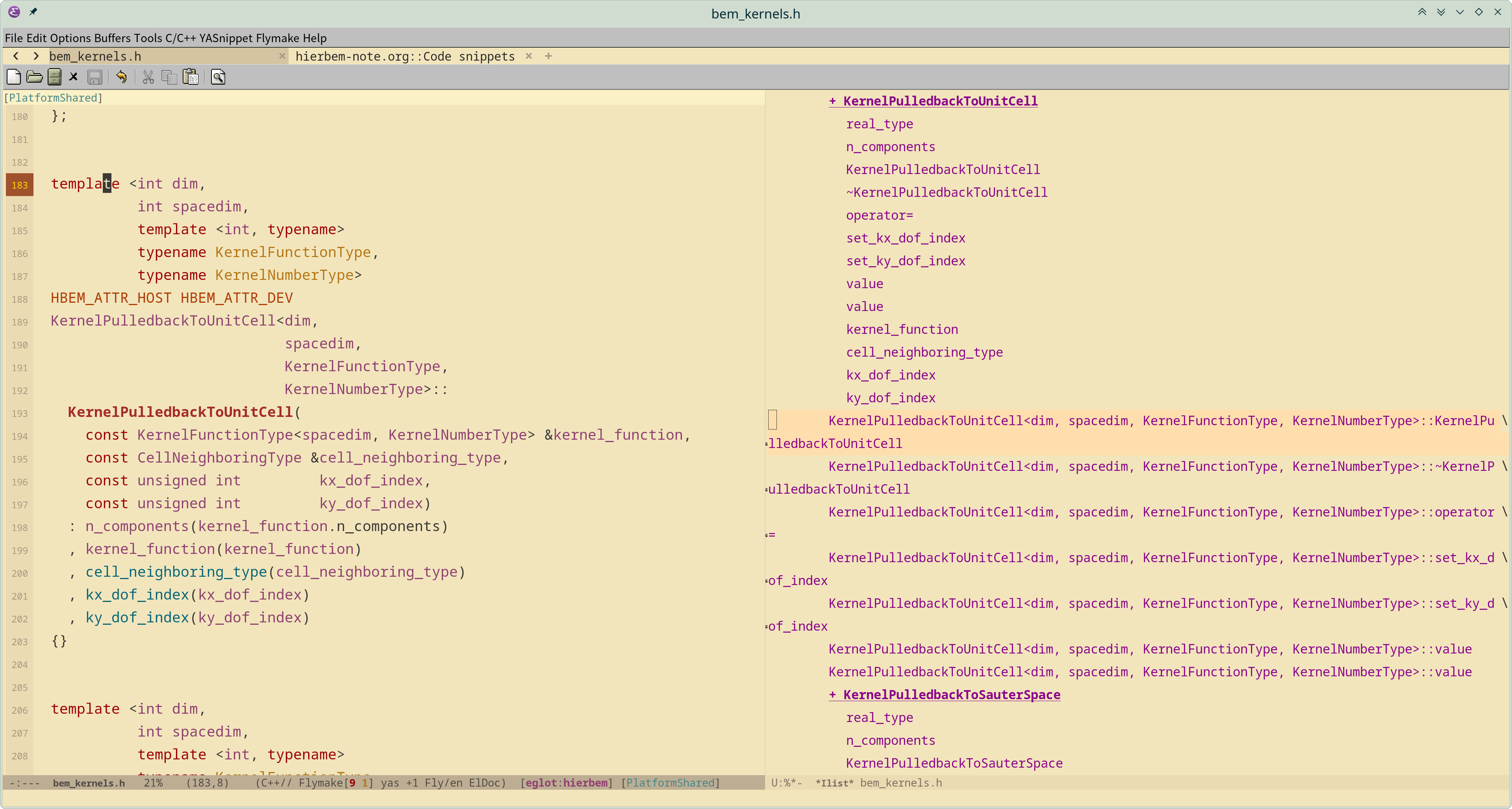
Swiss Army knife I use for developing HierBEM
imenu-list and eglot (with the clangd LSP backend) in Emacs provides good enough code navigation for C++ programming involving templates and overloaded functions. However, source code indexing with clangd consumes too much memory, for example, it may exhaust all 16 GB space in the tempfs partition mounted at /tmp, which terminates the indexing process.
Therefore, I have only adopted this tool set in HierBEM for checking header file inclusion (much more accurate than VS Code IntelliSense) and code review. During normal coding, I have to disable eglot along with clangd to reserve enough space in /tmp for building the project and avoid lagging GUI response.
Without the LSP support, I resort to consult-imenu for jumping to function definitions. consult-imenu is based on tree-sitter, as long as the c++-ts-mode is enabled. Template code and overloaded functions are well supported.
To jump to a symbol such as a class name or variable name, I visit a tag table (the TAGS file) via the cross reference functionality provided by xref, which supports the etags backend.
If all the above tools do not help to find the desired entity, I can finally rely on pattern matching in the whole project. Then my choice is rg, which calls the command line tool ripgrep.
Therefore, the ensemble of small tools, namely, imenu, imenu-list, consult, tree-sitter, eglot, clangd, etags, xref, rg, ripgrep, if appropriately used in different scenarios, makes developing and refactoring C++ numerical libraries such as HierBEM in Emacs both feasible and efficient.